

Research
UniBo Excavations in Arabia
Decades of University of Bologna archaeological research in Oman — from the Joint Hadd Project to ongoing missions at Ras Al-Hadd, Al-Khutm, Halban, and Romail.
Bronze Age
Ras Al-Hadd
Bronze Age coastal landscape around the HD-6 settlement and the HD-7/HD-10 necropolises, investigated by the University of Bologna for over thirty years.
Bronze Age
Al-Khutm
Part of the UNESCO area of Bat, Al-Khutm & Al-Ayn, where the University of Bologna joined the excavation of a monumental circular stone platform, conventionally called a 'tower'.
Bronze Age
Halban Necropolis
Monumental Bronze Age tombs on a limestone terrace in Al-Batinah, excavated since 2023 with digital survey, osteoarchaeology, and isotopic analysis.
Prehistoric
Romail Shelter
A prehistoric rock shelter between the Wahiba Sands and the Hajar Mountains, documenting the transition from Final Paleolithic to Neolithic about 10,000 years ago.
Forty years in Oman
From Maurizio Tosi's first campaigns at Ras Al-Hamra in the late 1970s to today's DiSCi and DBC projects, Bologna's archaeologists have shaped how the prehistory and protohistory of southeastern Arabia are understood.
History of research
A history of studies and the UniBo excavations
Interest in the Arabian Peninsula has a long history, rooting back to the explorations and geographical, historical, and epigraphic studies conducted between the modern and contemporary eras. As a structured field of research, however, the archaeology of Arabia consolidated between the nineteenth and twentieth centuries. Archaeological research has shown that the deserts, coasts, mountains, and oases of Arabia were not marginal spaces, but active components of historical landscapes in which diverse communities were able to develop forms of mobility, exchange, and innovation. Within this framework, the Arabian Peninsula has emerged as a key region for understanding the relations between Asia, Africa, and the Mediterranean.
Italian research, protection, and conservation activities in southern Arabia took shape in the 1970s through different yet complementary paths. They were inaugurated by Paolo Costa, active first in Yemen and then in Oman in the documentation and protection of cultural heritage; Enrico d’Errico, a central figure in the restoration of the Sultanate’s historic forts, castles, and architectures; and Maurizio Tosi, who launched the long season of Italian archaeological research in the region. At the beginning of the 1980s, Alessandro De Maigret also brought Italian archaeology to Yemen.
In 2026, the Ministry of Foreign Affairs and International Cooperation supports 13 Italian archaeological missions in Arabia, which rise to around twenty if the count is extended to southern Jordan and Iraq—geographically and historically closely connected areas to the Arabian Peninsula.
The University of Bologna in Arabia
In the Sultanate of Oman, the University of Bologna has developed a long tradition of archaeological research on the prehistory and protohistory of southeastern Arabia. From Neolithic communities to the cosmopolitan ports of the third millennium BCE, these projects have studied the relationship between territory, resources, settlements, and technologies, reconstructing Oman’s role in the exchange networks of the Indian Ocean.
The Joint Hadd Project
The heart of this tradition is the Joint Hadd Project, active since 1985 along the coast of central Oman, under the direction of Maurizio Tosi and subsequently Maurizio Cattani for the University of Bologna, and Serge Cleuziou for the CNRS and the Paris Panthéon-Sorbonne University. The project has reconstructed over the long term the transformation of coastal communities, from Neolithic ways of life to the birth of stable villages, specialized productions, and seaborne trade.
The two cornerstone sites are HD-6 at Ras Al-Hadd and RJ-2 at Ras Al-Jinz. HD-6 documents the transition, at the end of the fourth millennium, from small semi-nomadic coastal communities of the Neolithic to more complex and sedentary forms of settlement, linked to kinship and tribal networks, inland oases, and copper exploitation. With its mudbrick buildings, massive stone perimeter wall, and production areas, the village reveals a decisive phase in the formation of Arabian society at the beginning of the fourth millennium.
The excavation of RJ-2, on the other hand, has yielded a large coastal settlement fully integrated into a world of maritime traffic and long-distance contacts of the third millennium. The community lived on marine resources, produced specialized artifacts, and participated in the circulation of raw materials, objects, and ideas across the shores of the Arabian Sea. Although within a framework still deeply rooted in local resources and practices, the use of proto-writing signs and administrative tools was also experimented with in this context.
Connected to this trajectory is HD-1 at Ras Al-Hadd, a harbor site of extraordinary importance for understanding the commercial and cultural relations between Oman, the Indus Valley, and Iran. The variety of imported materials and local productions shows the role of the Omani coast in the networks of the Indian Ocean at the end of the third millennium BCE.
The Joint Hadd Project has also investigated the Neolithic roots of coastal societies through the excavation of sites such as HD-2 and HD-5 at Ras Al-Hadd and KHB-1 at Ras Al-Khabbah, linked to the seasonal exploitation of marine resources between the fifth and fourth millennia.
The Ships of Magan
From the research of the Joint Hadd Project, a further project was born: the Magan Boat Project, dedicated to the experimental study of Bronze Age naval technologies. The project started from the comparison between third-millennium cuneiform texts, which mention “Magan ships” built with bundles of reeds and bitumen, and the discovery at Ras Al-Jinz of bitumen fragments from the waterproofing lining of ancient hulls, in which impressions of reeds, ropes, mats, wood, and marine organisms had remained. Based on this evidence, a first full-scale prototype of a Magan ship was built and launched in Ravenna in 2002, while an advanced model was built and tested in Sur, in the Sultanate of Oman, in 2005. Through these reconstructions, experimental archaeology made visible the technical base of the first maritime exchanges across the Arabian Sea and contributed to the training of a generation of students and young researchers from the University of Bologna, who developed new expertise and significant research on ancient naval technologies from this experience.
The Neolithic Communities of Ras Al-Hamra
Research at Ras Al-Hamra, in the Bay of Muscat, represents one of the founding chapters of Italian archaeology in Oman. The first investigations, launched by Maurizio Tosi at the end of the 1970s and continued in the 1980s with the excavations of RH-5 and RH-6, documented communities of hunter-gatherer-fishers deeply linked to marine resources and mangrove environments. In the 2000s, as part of projects promoted by Omani institutions, numerous students and young researchers from the University of Bologna participated in new preventive archaeology campaigns that allowed for a more precise reconstruction of the organization of settlements and burial practices of the fifth and fourth millennia. Ras Al-Hamra thus emerged as a complex social landscape where daily life, coastal economy, rituals, and environmental transformations intertwined for millennia.
Educational and Training Research
Over the course of more than thirty years, hundreds of students from the University of Bologna have participated in missions in the Sultanate of Oman, often experiencing their first excavation and their first encounter with distant cultural contexts, thus training not only as researchers but also as more aware citizens. Furthermore, the University of Bologna has supported numerous research projects born from degree theses, PhDs, and post-doctoral paths. These studies have explored multiple aspects of the prehistory and protohistory of Arabia, from the exploitation of animal and plant resources to lithic technologies, from the production of ornaments to physical anthropology and funerary landscapes, up to the exchange networks that connected the Oman Peninsula with overseas regions.
Consultancy, Heritage, and Business
The role of the University of Bologna in Oman has not been limited to field research but has also included consultancy activities for the Omani government institutions responsible for archaeological research and cultural heritage protection. Between 1976 and 1986, Paolo Costa, who was also Professor of Islamic Archaeology at the Alma Mater, contributed to the foundation and organization of the Sultanate’s heritage protection structures. Between 2010 and 2016, Maurizio Tosi, Professor of Paleoethnology in Ravenna and Bologna, accompanied a new phase of development in Omani archaeology, spanning the valorization of research, museum development, preventive archaeology, and physical and digital archives.
Over the years, the University of Bologna has also acted as a liaison between Omani authorities and Bolognese companies and professional firms, fostering the involvement in Oman of entities like F+LR Architettura, which designed archaeological parks, museums, and specialized buildings for the conservation and study of archaeological materials.
The University of Bologna in Oman: Ongoing Project
The archaeological research of the University of Bologna in Oman continues today through projects conducted by various groups within the University, in collaboration with Omani institutions and with the support of the Ministry of Foreign Affairs and International Cooperation (MAECI). The Department of History and Cultures (DiSCi) continues, with Maurizio Cattani, investigations into the Bronze Age at Ras Al-Hadd and in the UNESCO area of Bat, Al-Khutm & Al-Ayn, while Elena Maini studies the exploitation of dolphins in the prehistory of Arabia. Meanwhile, the Department of Cultural Heritage (DBC), with Eugenio Bortolini and Stefano Benazzi, develops research dedicated to the Bronze Age necropolis of Halban and the prehistoric rock shelter of Romail.
Taken as a whole, these projects show how the research of the University of Bologna in the Sultanate of Oman—while remaining coherently oriented toward the study of socio-technical complexity in the prehistoric cultures of southeastern Arabia—has been able to expand, refine, and evolve over the years. Settlements, necropolises, monumental architecture, prehistoric shelters, and marine resources do not represent separate spheres, but parts of a unified scientific path, in which each project has progressively integrated new data and new perspectives, allowing shared questions to be addressed across different lines of investigation. What emerges is a research endeavor capable of renewing itself without losing coherence, connecting different sites, methods, and periods within a comprehensive vision of Oman’s oldest history.
Looking to the future, the research of the University of Bologna in Oman will continue to engage with the new frontiers of archaeology and with the priorities of a country in constant transformation, contributing to the knowledge, protection, and valorization of the Sultanate’s cultural heritage.
On the ground today
The current UniBo excavations in Arabia
Ras Al-Hadd: Research, Protection, and Valorization
At Ras Al-Hadd, along the coast of Oman, the research of the University of Bologna focuses on the archaeological landscape surrounding the settlement of HD-6, one of the most important sites for understanding the transformation of coastal communities at the beginning of the Bronze Age. The village, which developed between the end of the fourth and the beginning of the third millennium, included large mudbrick buildings and areas linked to the exploitation of marine resources, the processing of copper minerals, and the production of stone and shell ornaments. On the rocky terraces behind HD-6 lie the necropolises of HD-7 and HD-10, whose excavation completes the interpretation of this territory. The study of small groups of circular stone tombs has allowed for a better understanding of funerary rituals, social relations, and the way in which these communities constructed the memory of their ancestors during the third millennium BCE.
The research is also conducted with a view to creating an archaeological park, featuring visitor routes, informative panels, viewpoints, and communication tools capable of connecting the numerous contexts of the Ras Al-Hadd area. The project presents this territory as a complex cultural landscape, in which settlements, tombs, lagoons, and natural resources tell a long history of human adaptation.
Al-Khutm: A Monumental ‘Tower’ in the UNESCO Area of Bat
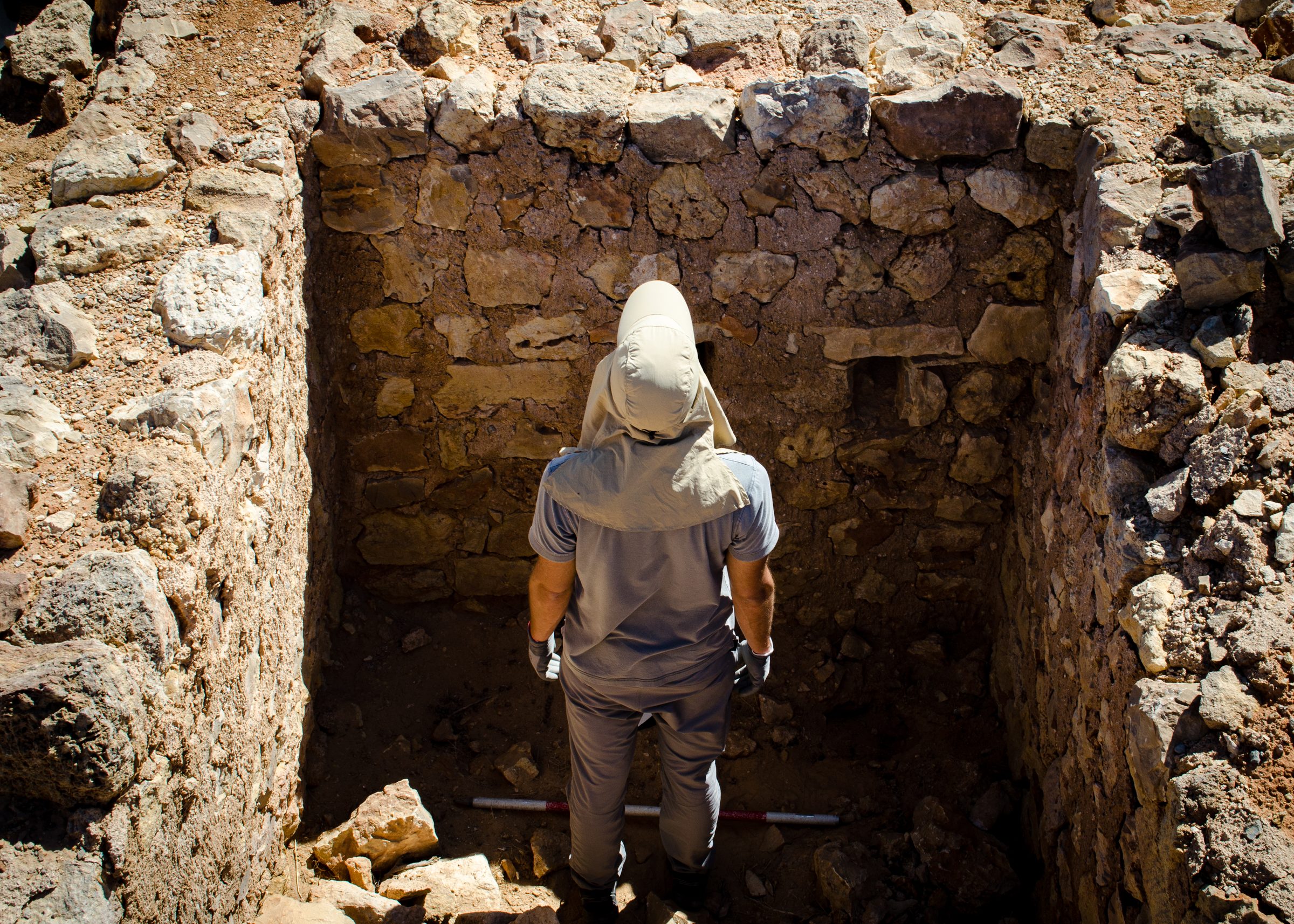
In the hinterland of Oman, the Al-Khutm project is part of the UNESCO area of Bat, Al-Khutm & Al-Ayn, one of the most important Bronze Age archaeological landscapes in Arabia. The project of the Ministry of Heritage and Tourism of the Sultanate of Oman saw the participation of the Department of History and Cultures in the excavation of a large, monumental circular stone platform, conventionally defined as a ‘tower’, which was used between the late third and the second millennium.
The excavations have revealed a large structure with a complex layout, featuring internal rooms, corridors, entrances, lateral spaces, and a central well. The most recent campaigns have also brought to light a massive perimeter wall, showing that the complex was broader than the central platform alone. Today, three-dimensional surveys and digital maps allow researchers to track the construction phases of the monument and make it more understandable to visitors.
DExPO: Dolphins in the Prehistory of Arabia
Building on the research at Ras Al-Hadd and Ras Al-Jinz, the DExPO Project has introduced a zooarchaeological approach to the study of dolphins in the prehistory of Oman. Developed in collaboration between ArcheoLaBio – Bioarchaeology Research Centre of the University of Bologna and the Natural History Museum of Oman, the project applies an experimental analytical protocol to identify the different species of marine mammals exploited in coastal economies between the Neolithic and the Bronze Age. The first results show that the exploitation of dolphins was not a marginal event, but a fundamental component of subsistence strategies along the coasts of southeastern Arabia.
Halban: Monumental Tombs of the Bronze Age
Halban, in the coastal region of Al-Batinah, preserves a monumental funerary site from the Bronze Age, located on a limestone terrace between the coastal plain and the Hajar Mountains. The site’s position along a natural corridor between the coast and the mountains makes it a privileged vantage point for understanding the development of local communities throughout the entire third millennium and regional exchanges in the area.
The investigations combine archaeological excavation, digital survey, osteoarchaeology, and biochemical and isotopic analyses. Together with physical anthropology, they allow for the reconstruction of the biological profile of individuals—identifying men, women, and children—as well as the evaluation of possible forms of mobility along the trade routes that crossed the Arabian Sea during the third millennium. The results demonstrate how the tombs of Halban tell not only of monumental architecture, funerary rituals, and grave goods, but also stories of people, communities, and contacts between distant regions.
The Alma Mater’s project will not only contribute to the historical reconstruction of the site but will also provide the basis for the creation of a future archaeological park. Thanks to its strategic position just north of Muscat, Halban will be able to attract a significant flow of tourists, becoming a reference point for the knowledge of Omani protohistory. The virtual reconstruction of the tombs, alongside informative panels and observation points, will help visitors understand an archaeological landscape that is fundamental to the history of ancient societies in Oman.
Romail: A Prehistoric Rock Shelter Between Desert and Mountains
The natural rock shelter of Romail, in central Oman, is located between the edge of the great Wahiba Sands desert and the Hajar Mountains, in an area rich in raw materials suitable for the production of stone tools and close to water resources. The site offers precious evidence on the transitional phase between Final Paleolithic communities and the first Neolithic groups about 10,000 years ago.
Excavations have brought to light chipped stone tools, such as blades and arrowheads, hearths, burnt animal remains, and stone and shell ornaments. These data indicate that the shelter was used for diverse activities, ranging from stone processing to temporary stops and the exploitation of local resources. Ongoing radiometric and technological analyses on the recovered materials will help clarify more precisely when, how, and by whom the site was frequented.
Romail also preserves a rich assemblage of rock art from periods subsequent to the occupation between the Final Paleolithic and Early Neolithic, featuring red ochre paintings, human and animal figures, horsemen, and geometric motifs. The project thus combines prehistoric archaeology, landscape study, materials analysis, and digital documentation, offering new perspectives on the oldest communities that inhabited southeastern Arabia.
Excavation map
Click any marker for mission details and links. Map data © OpenStreetMap contributors.
Scientific References
Selected scholarly sources underpinning the exhibition's panels and research.
General, diachronic works & history of research
- Al-Ghabban, A. I., André-Salvini, B., Demange, F., Juvin, C., and Cotty, M. (2010). Roads of Arabia: Archaeology and History of the Kingdom of Saudi Arabia. Musée du Louvre and Somogy Art Publishers.
- Cleuziou, S., and Tosi, M. (2020). In the Shadow of the Ancestors: The Prehistoric Foundations of the Early Arabian Civilization in Oman. Second Expanded Edition. Archaeopress Publishing Ltd.
- De Maigret, A. (2002). Arabia Felix. Un viaggio nell’archeologia dello Yemen. Rusconi.
- Döpper, S. (2023). The Reuse of Tombs in Eastern Arabia. Arabia Orientalis: Studien zur Archäologie Ostarabiens 7. Archaeopress Publishing Ltd.
- Fossati, A. E. (2019). Messages from the Past: Rock Art of Al-Hajar Mountains. The Archaeological Heritage of Oman 4. Archaeopress Publishing Ltd.
- Frenez, D., and Cattani, M. (2019). Sognatori. 40 anni di ricerche archeologiche italiane in Oman / Dreamers. 40 Years of Italian Archaeological Research in Oman. BraDypUS.
- Gernez, G., and Giraud, J. (2019). Taming the Great Desert: Adam in the Prehistory of Oman. The Archaeological Heritage of Oman 3. Archaeopress Publishing Ltd.
- Hoyland, R. G. (2002). Arabia and the Arabs: From the Bronze Age to the Coming of Islam. Routledge.
- Loreto, R. (2018). Storia e archeologia della Penisola arabica. Collana Didattica 5. Istituto per l’Oriente C. A. Nallino.
- Magee, P. (2014). The Archaeology of Prehistoric Arabia: Adaptation and Social Formation from the Neolithic to the Iron Age. Cambridge World Archaeology. Cambridge University Press.
- Mouton, M. (2024). Deux campagnes de prospections au Yémen: 1992–1993. International Association for the Study of Arabia Monographs 21. Archaeopress Publishing Ltd.
- Newton, L. S., and Zarins, J. (2019). Dhofar Through the Ages: An Ecological, Archaeological and Historical Landscape. The Archaeological Heritage of Oman 1. Archaeopress Publishing Ltd.
- Williams, K. D., and Gregoricka, L. A. (2019). Mortuary and Bioarchaeological Perspectives on Bronze Age Arabia. Bioarchaeological Interpretations of the Human Past: Local, Regional, and Global Perspectives. University Press of Florida.
Paleolithic & Neolithic
- Bretzke, K., Crassard, R., and Hilbert, Y. H. (2020). Stone Tools of Prehistoric Arabia: Papers from the Special Session of the Seminar for Arabian Studies Held on 21 July 2019. Supplement to the Proceedings of the Seminar for Arabian Studies 50. Archaeopress Publishing Ltd.
- Carter, R. A., and Crawford, H. E. W. (2010). Maritime Interactions in the Arabian Neolithic: Evidence from H3, As-Sabiyah, an Ubaid-Related Site in Kuwait. American School of Prehistoric Research Monograph Series 8. Brill.
- Drechsler, P. (2018). Dosariyah: An Arabian Neolithic Coastal Community in the Central Gulf. International Association for the Study of Arabia Monographs 19. Archaeopress Publishing Ltd.
- Marcucci, L. G., Badel, E., and Genchi, F. (2021). Prehistoric Fisherfolk of Oman: The Neolithic Village of Ras Al-Hamra RH-5. The Archaeological Heritage of Oman 6. Archaeopress Publishing Ltd.
- Masry, A. H. (1997). Prehistory in Northeastern Arabia: The Problem of Interregional Interaction. Kegan Paul International.
- McCorriston, J. (2023). Persistent Pastoralism: Monuments and Settlements in the Archaeology of Dhofar. The Archaeological Heritage of Oman 10. Archaeopress Publishing Ltd.
- Méry, S., and Lidour, K. (2025). Umm al-Quwain 2: A Neolithic Settlement and Graveyard in the United Arab Emirates. Archaeopress Archaeology. Archaeopress Publishing Ltd.
- Rose, J. I. (2022). An Introduction to Human Prehistory in Arabia: The Lost World of the Southern Crescent. Springer.
- Rose, J. I., Hilbert, Y. H., Marks, A. E., and Usik, V. I. (2019). The First Peoples of Oman: Palaeolithic Archaeology of the Nejd Plateau. The Archaeological Heritage of Oman 5. Archaeopress Publishing Ltd.
- Scott-Jackson, J. (2021). Qatar: Evidence of the Palaeolithic: Earliest People Revealed. Archaeopress Archaeology. Archaeopress Publishing Ltd.
Bronze Age
- Al-Tikriti, W. Y., and McSweeney, K. (2025). Two Late Umm an-Nar Tombs at Mowaihat-Ajman, United Arab Emirates: Excavations and Human Bone Remains. International Association for the Study of Arabia Monographs 23. Archaeopress Publishing Ltd.
- Crawford, H. E. W. (1998). Dilmun and Its Gulf Neighbours. Cambridge University Press.
- Döpper, S. (2024). Landmarks of Identity: Bronze Age Towers of the Oman Peninsula. The Archaeological Heritage of Oman 13. Archaeopress Publishing Ltd.
- Giardino, C. (2019). Magan: The Land of Copper: Prehistoric Metallurgy of Oman. The Archaeological Heritage of Oman 2. Archaeopress Publishing Ltd.
- Højlund, F. (2008). The Burial Mounds of Bahrain: Social Complexity in Early Dilmun. Jysk Arkæologisk Selskabs Skrifter 58. Aarhus University Press.
- Højlund, F. (2019). Qala’at al-Bahrain 3: The Western and Southern City Walls and Other Excavations. Jysk Arkæologisk Selskabs Skrifter 30:3. Aarhus University Press.
- Laursen, S. T., and Steinkeller, P. (2017). Babylonia, the Gulf Region, and the Indus: Archaeological and Textual Evidence for Contact in the Third and Early Second Millennia B.C. Mesopotamian Civilizations 21. Eisenbrauns.
- Potts, D. T. (1990). The Arabian Gulf in Antiquity. Volume I: From Prehistory to the Fall of the Achaemenid Empire. Oxford University Press.
- Williams, K. D. (2024). Landscapes of Death: Early Bronze Age Tombs and Mortuary Rituals on the Oman Peninsula. The Archaeological Heritage of Oman 12. Archaeopress Publishing Ltd.
Iron Age & Late Antiquity
- Al-Jahwari, N. S., Yule, P. A., Douglas, K. A., Pracejus, B., Al-Belushi, M. A. K., and ElMahi, A. T. (2021). The Early Iron Age Metal Hoard from the Al Khawd Area (Sultan Qaboos University), Sultanate of Oman. The Archaeological Heritage of Oman 7. Archaeopress Publishing Ltd.
- Avanzini, A. (2016). By Land and by Sea: A History of South Arabia before Islam Recounted from Inscriptions. Arabia Antica. Philological Studies 10. L’Erma di Bretschneider.
- Avanzini, A., and Degli Esposti, M. (2018). Husn Salut and the Iron Age of South East Arabia: Excavations of the Italian Mission to Oman 2004–2014. Arabia Antica 15. L’Erma di Bretschneider.
- Döpper, S., Biezeveld, I., Maiorano, M. P., and Kluge, J. (2024). The 2018 Archaeological Survey at Tawi Said, Sultanate of Oman. Arabia Orientalis: Studien zur Archäologie Ostarabiens 8. Archaeopress Publishing Ltd.
- Fisher, G. (2015). Arabs and Empires before Islam. Oxford University Press.
- Garba, R. (2025). Hinterland Monuments of Ancient Nomads: Trilith Stone Structures of Southeastern Arabia. The Archaeological Heritage of Oman 15. Archaeopress Publishing Ltd.
- Grasso, V. A. (2023). Pre-Islamic Arabia: Societies, Politics, Cults and Identities during Late Antiquity. Cambridge University Press.
- Potts, D. T. (1990). The Arabian Gulf in Antiquity. Volume II: From Alexander the Great to the Coming of Islam. Oxford University Press.
- Yule, P. A. (2014). Cross-roads: Early and Late Iron Age South-eastern Arabia. Abhandlungen der Deutschen Orient-Gesellschaft 30. Harrassowitz Verlag.
- Yule, P. A., and Mauro, F. (2025). At the Dawn of History: The Late Pre-Islamic Age in South-Eastern Arabia. The Archaeological Heritage of Oman 14. Archaeopress Publishing Ltd.
Islamic period
- Bosworth, C. E. (1996). The New Islamic Dynasties: A Chronological and Genealogical Manual. Columbia University Press.
- Clarizia, V. (2022). Ancient Weapons of Oman. Volume 1: Edged Weapons. The Archaeological Heritage of Oman 8. Archaeopress Publishing Ltd.
- Clarizia, V. (2022). Ancient Weapons of Oman. Volume 2: Firearms. The Archaeological Heritage of Oman 9. Archaeopress Publishing Ltd.
- Esposito, J. L. (1999). The Oxford History of Islam. Oxford University Press.
- Filoramo, G. (1999). Islam. Laterza.
- Hansman, J. (1985). Julfār, an Arabian Port: Its Settlement and Far Eastern Ceramic Trade from the 14th to the 18th Centuries. Prize Publication Fund 22. Royal Asiatic Society of Great Britain and Ireland.
- Insoll, T. (2005). The Land of Enki in the Islamic Era: Pearls, Palms and Religious Identity in Bahrain. Kegan Paul.
- Kennet, D. (2004). Sasanian and Islamic Pottery from Ras al-Khaimah: Classification, Chronology and Analysis of Trade in the Western Indian Ocean. Society for Arabian Studies Monographs 1; BAR International Series 1248. Archaeopress.
- Lo Jacono, C. (2004). Storia del mondo islamico (VII–XVI secolo). Vol. 1: Il Vicino Oriente. Einaudi.
- Milwright, M. (2010). An Introduction to Islamic Archaeology. Edinburgh University Press.
- Rougeulle, A. (2015). Sharma: Un entrepôt de commerce médiéval sur la côte du Ḥaḍramawt (Yémen, ca 980–1180). International Association for the Study of Arabia Monographs 17. Archaeopress Publishing Ltd.
- Rougeulle, A. (2023). Qalhat, a Medieval Port City of Oman: From a Field of Ruins to UNESCO. The Archaeological Heritage of Oman 11. Archaeopress Publishing Ltd.
- Walker, B. J., Insoll, T., and Fenwick, C. (2021). The Oxford Handbook of Islamic Archaeology. Oxford Handbooks. Oxford University Press.
Web sources
Epigraphic databases
- DASI – Digital Archive for the Study of Pre-Islamic Arabian Inscriptions https://dasi.cnr.it/
- OCIANA – Online Corpus of the Inscriptions of Ancient North Arabia https://ociana.osu.edu/
- DiCoNab – Digital Corpus of the Nabataean and Developing Arabic Inscriptions https://diconab.huma-num.fr/inscriptions/
- Thesaurus d’Épigraphie Islamique https://maxvanberchem.org/en/thesaurus-d-epigraphie-islamique
- Sabaic Online Dictionary https://sabaweb.uni-jena.de/SabaWeb/
- Mnamon – Antiche scritture del Mediterraneo https://mnamon.sns.it/
Ancient Arabia & epigraphy
- Ancient Arabia https://ancientarabia.huma-num.fr/
- Open Digital Epigraphy Hub – EpiHub https://open-epihub.cnr.it/
Archaeological databases & archives
- EAMENA – Endangered Archaeology in the Middle East and North Africa https://database.eamena.org/
- ArchaeOman https://www.archaeoman.de/en/
- Arabian Rock Art Heritage https://saudi-archaeology.com/
- Manar al-Athar https://www.manar-al-athar.ox.ac.uk/
- Qatar Digital Library https://www.qdl.qa/en